





























What the boids screensaver is
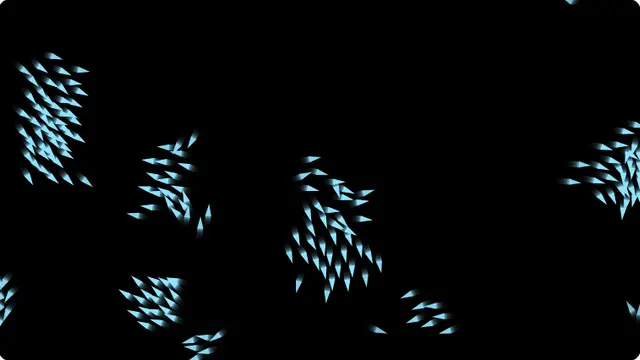
The rules are Craig Reynolds’, published in 1986, and there are only three. Steer away from anyone too close. Match the average heading of the birds you can see. Move towards where that group is. Nothing else — no flock object, no destination, no coordination between any two birds beyond what each can see for itself.
What comes out is a textbook case of emergence: behaviour that exists at the level of the group without existing anywhere in the rules. Reynolds’ demo is why nearly every crowd or flock in film since has been simulated rather than animated, and it took a decade to reach the screen in Batman Returns.
- A calm but never static display for an office or a lobby
- A live illustration of emergent behaviour for teaching
- A background with movement that does not demand attention
Flocking simulation as a screensaver
Flock size changes the character completely, not just the count. Forty birds spend most of their time as two or three loose groups that rarely meet; two hundred is where the recognisable wheeling starts; five hundred behaves like a single body with waves passing through it. Each bird is shaded by how many neighbours it currently has, so dense knots in the flock are visibly brighter as they form and dissolve.
The birds are turned away from the edges rather than bounced or wrapped around. A bounce puts a visible crease through the flock, and wrapping breaks the sense that neighbours are neighbours.
How to run the boids screensaver full screen
Press the fullscreen button on the player, or the F key. Escape brings you back to the page. On a desktop browser F11 does the same job and hides the browser’s own toolbars as well, which is what you want on a display that is going to be left running.
Everything you change in the settings is written into the address bar as you change it, so the version you have set up is a link. Bookmark it, or send it to whoever is running the screen. Space pauses and resumes at any time.