
Skip to content
Browser Screensaver

Grid Alignment Test

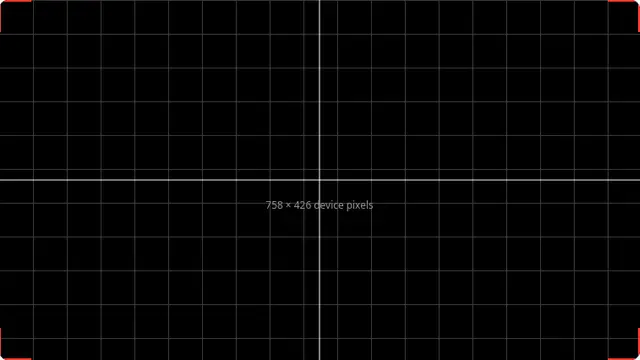
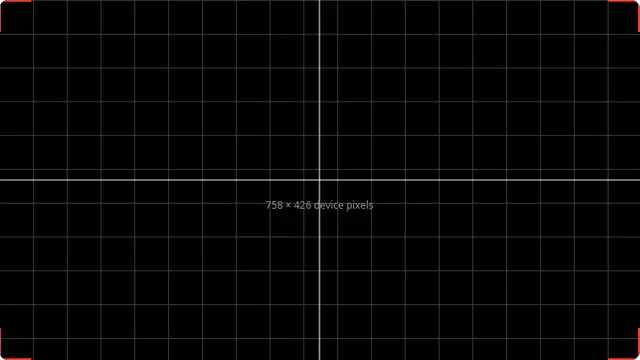
A regular grid with corner brackets and a centre crosshair. If a bracket is cut off, your display is cropping the signal.

Press F for fullscreen, Esc to exit.

What the grid alignment test shows

The corner brackets are the useful part. They sit right at the edge of the image, so if you cannot see all four complete, something between the source and the panel is cropping — almost always overscan, which televisions still enable by default in some picture modes.

The grid itself checks that horizontal and vertical spacing is even across the panel. Scaling artefacts show up as lines that are thicker in some places than others, which means the display is not running at its native resolution.

What the grid tells you

All four corner brackets fully visible means no overscan. A missing bracket means the display is cropping the edges of the picture, and the fix is in the display’s own menu — look for "overscan", "just scan", "screen fit" or "1:1 pixel mapping".

Lines of uneven thickness mean the image is being scaled. Set the source to the panel’s native resolution and the lines should become uniform.

Questions

Why can I not see the corner markers?

Overscan. Some televisions crop a few per cent off every edge by default, a habit inherited from analogue broadcast. Look for "just scan", "screen fit", "full pixel" or "1:1" in the picture settings.

Why are some grid lines thicker than others?

The image is being scaled rather than shown at native resolution. Scaling cannot split a pixel, so some lines land on one pixel and others on two. Set the source to the panel’s native resolution.

Is this useful on a laptop screen?

Less so — laptops rarely overscan. It is most useful on televisions and on projectors, where cropping and geometry problems are common.

Is the grid alignment test free?

Yes — free, with no account, no download and no limit. It is a web page, so it runs on any device with a modern browser.

Do I need to be fullscreen?

For anything involving the whole panel, yes. Press F, or the fullscreen button. On a desktop browser F11 also hides the browser toolbars, which matters for the tests where a bright strip at the top of the screen would affect what you are looking at.